


Nowhere is the fight for online visibility fiercer than in the personal injury market. The firms that grow are the ones that treat SEO as a core driver of their business, not an afterthought.
Every day, thousands of people search for personal injury lawyers on Google. And now, that competition extends to AI platforms like ChatGPT, Perplexity, and Gemini.
The firms that win visibility in traditional and AI search are the ones with a solid SEO foundation, a clear strategy, and consistent execution of SEO tactics.
Whether you’re a solo practitioner building your name, a growing firm entering new markets, or an established regional practice protecting your position, SEO remains one of the most effective ways to reach your business goals.
So ask yourself: Is your law firm positioned to win?
Why SEO Matters for Personal Injury Lawyers
There is a massive market of potential clients searching for personal injury lawyers online. In every major metro in the U.S., thousands of people turn to Google each day when they need legal help.
Most popular personal injury lawyer search term in each of the most populous U.S. metro areas | ||
Metro Area | Query | Monthly Search Volume |
New York | new york personal injury lawyer | 3,600 |
Los Angeles | personal injury lawyer los angeles ca | 5,400 |
Chicago | personal injury attorney chicago | 4,400 |
Dallas | personal injury attorney dallas | 2,600 |
Houston | personal injury lawyer houston | 8,100 |
Philadelphia | personal injury attorney in philadelphia | 3,600 |
Miami | personal injury lawyer miami | 1,600 |
Atlanta | personal injury lawyer atlanta | 5,400 |
Boston | boston personal injury lawyer | 2,400 |
Phoenix | personal injury lawyer in phoenix az | 2,400 |
Source: Semrush | ||
Mid-sized and smaller markets also see substantial search volume that can fuel meaningful, sustained growth for firms that show up consistently.
Personal injury lawyer search terms in midsize cities | ||
City | Query | Monthly Search Volume |
Boise, ID | boise personal injury lawyer | 200 |
Colorado Springs, CO | personal injury lawyer colorado springs | 1,000 |
Huntsville, AL | huntsville personal injury lawyer | 600 |
Omaha, NE | omaha personal injury lawyer | 700 |
Durham, NC | durham personal injury lawyer | 200 |
Madison, WI | personal injury lawyer madison | 200 |
Salt Lake City, UT | salt lake city personal injury lawyer | 350 |
Des Moines, IA | des moines personal injury lawyer | 500 |
Source: Ahrefs | ||
The firms that get found are the firms that grow. If you’re not actively investing in your visibility, you’re leaving cases and revenue on the table.
SEO can increase leads for personal injury firms
Yes. With the right strategy and disciplined execution, SEO can turn your digital presence into signed cases.
We’ve seen it firsthand with our personal injury clients across the United States.
Personal Injury SEO Results | ||
Personal injury firm in western U.S. 38% more signed cases in less than 12 months 84 additional organic cases | Personal injury firm in northeast 2x signed cases in less than 12 months 161 addtional organic cases | Personal injury firm in Florida 116% more signed cases in 12 months 2x impressions in 3 months |
Personal Injury Requires a Robust SEO Strategy
Modern search results are no longer simply “ten blue links” and a map. That means planning for visibility across multiple platforms.
A basic SEO strategy may prioritize some channels over others, but it should be built with an understanding of where legal consumers in your market are actually searching, and which mediums are most relevant to your firm.
Many search results also include People Also Ask, Videos or Short Videos, and Discussions and Forums, which create additional paths for potential clients to discover your firm.
Elements of the Google SERP for Personal Injury Lawyers | |
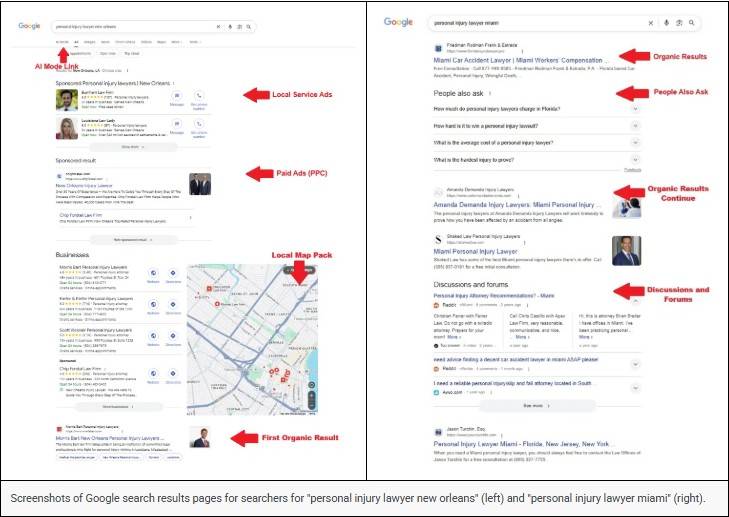
Local Service Ads (LSAs): Ads at the top of Google; firms pay by the lead. Often labeled as "Sponsored Personal injury lawyers." Includes Google rating, practice area (e.g., Personal injury lawyers), years in business, phone number, and other business information. | |
Pay Per Click (PPC) Ads: Ads near the top of Google, often under LSAs; firms pay by the click. Often labeled "Sponsored results," they appear above other SERP features, including organic results. Some search results pages feature PPC ads near the bottom of page one, too. | |
Local Map Packs (a.k.a. Google Local Pack): Map-based search results that appear under ads on many commercial and transactional search results pages. Often includes a map with pins identifying locations of personal injury firms near the user's location. Many local packs include three business listings and some include a Sponsored ad. | |
Organic Results: These are the traditional "10 blue links" that Google was originally built on. They've been pushed way down the search page, but they still garner a large share of clicks. Ranking in the top organic results still carries considerable value for personal injury firms. | |
AI Overview & AI Mode: Google’s native AI features are prominent on many search results pages. Informational queries are more likely to trigger an AI Overview than transactional and commercial queries. However, all users can click the AI Mode link at the top of the search results page to use Google’s native chatbot-like search feature. | |
Look at all the ways to get found in Google search.
And search has expanded beyond Google. AI platforms increasingly handle the types of questions that used to begin in Google. Personal injury firms now need strategies that earn visibility in large language models (LLMs) like ChatGPT, Gemini, and Perplexity.
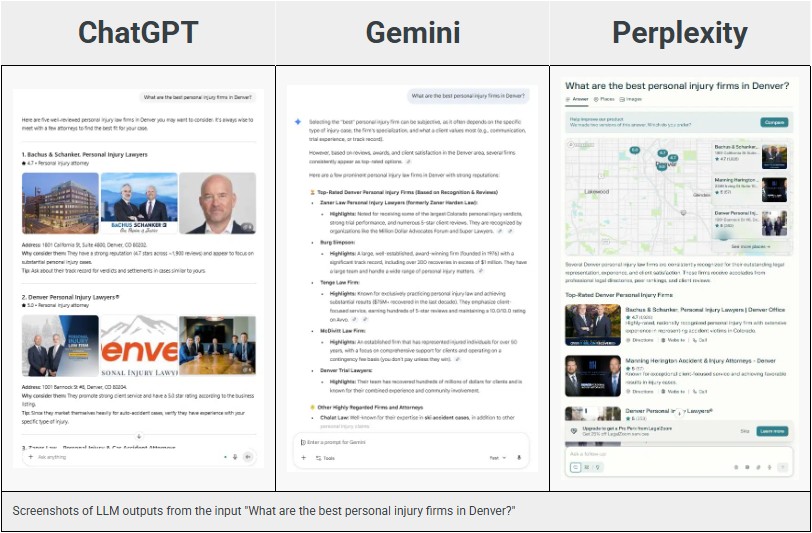
A modern SEO strategy must evaluate where legal consumers are searching for personal injury lawyers, not just Google organic, not just maps, not just ads, and not just AI.
But understanding where clients search is only one part of building an effective SEO plan. Personal injury firms should also account for variables unique to their firm.
Read about how we helped a personal injury firm in the northeast achieve steady gains year after year.
Custom SEO Strategies Are Crucial
No two SEO strategies should ever look exactly the same. Consider two personal injury firms:
- A mid-sized practice with five attorneys, strong brand recognition, and plans to expand into a new market.
- A solo attorney with a simple website and a goal of generating her first online lead.
These firms should not share the same strategy. They have different goals and vastly different starting points. Yet many agencies rely on cookie-cutter packages that apply the same mix of content, links, and technical work to every client, setting the same general goals and using the same goalposts to measure success regardless of the firm’s actual needs.
We don’t do cookie-cutter strategies. When we begin working with a personal injury firm, we start by understanding the firm’s goals and previous marketing efforts and designing a roadmap around its search and business needs.
- Current performance: We assess how you’re performing now, what needs to improve, areas worth doubling down, and which efforts aren’t moving the needle.
- Website health: We perform a full technical audit to evaluate structural issues, speed problems, UX barriers, and other factors that can quietly hold back your search performance.
- Budget: Some firms invest aggressively in SEO to scale faster and compete quickly in tougher markets. Others work within tighter budgets, relying on precision, creativity, and a bit more patience. Both can succeed with the right strategy.
- Market and competition: Ranking in Los Angeles is nothing like ranking in Norman, Oklahoma. Competition varies widely, and your strategy should account for the competition in your market(s).
- Growth plans: Looking for your first online lead? Expanding practice areas? Entering new cities? Going statewide or national? We’ve guided firms through all stages of growth, and SEO is often a smart foundation for expansion.
That’s exactly how we helped a personal injury firm in Florida quadruple its signed cases and grow into two new offices.
Even with these core elements, your strategy isn’t complete unless it accounts for how the search journey itself is evolving.
Personal injury SEO strategies should plan for the evolving search journey
AI is changing how legal consumers search. While Google remains the dominant platform, more users now turn to tools like ChatGPT, Gemini, and Perplexity in the early stages of their journey. And even within Google, features like AI Overviews and AI Mode are reshaping how users find information.
The path someone takes to hire a lawyer isn’t linear. People don’t take the same route to hiring a lawyer:
- Some start by researching the law or personal injury claims.
- Some jump straight to comparing personal injury firms.
- Others contact the first reputable firm they find, whether through maps, organic results, LSAs, or an AI recommendation.
- Many search directly for firms they’ve seen offline (TV, radio, community signage).
Your SEO strategy should address each type of user by planning for the full spectrum of search intent:
- Informational intent: Early-stage research (“how long do I have to file a car accident claim?”)
- Commercial intent: Comparing options (“best car accident lawyer near me”)
- Transactional intent: Ready to contact (“car accident lawyer Miami”)
- Navigational intent: Branded searches (“Smith & Jones injury lawyers”)
(Some search queries have multiple intents, usually ‘personal injury lawyer’ type terms that can be commercial or transactional.)
Major platforms, including Google, ChatGPT, Gemini, and Perplexity, can each serve all these intents. But users tend to prefer certain platforms for different stages of the search journey.
AI platforms are increasingly popular for research-heavy, informational queries. For example:
- “How long after a car accident can injuries show up?”
- “Should I see a doctor after a car accident even if I feel fine?”
- “What damages can I claim in a car accident case?”
Google’s own behavior reflects this shift. An Ahrefs study found Google serves AI Overviews far more often for informational queries than for commercial, transactional, or navigational searches.
AI Overview trigger rate, by search intent | Share of AI Overviews, by search intent |
Informational queries | Informational queries |
Commercial queries | Commercial queries |
Transactional queries | Transactional queries |
Navigational queries | Navigational queries |
Source: Ahrefs Note: Total percentage may exceed 100% because some queries have multiple intents. | |
But consumers still turn to Google Maps, organic listings, LSAs, and ads when they’re ready to find a lawyer and take action. Still, even AI platforms can recommend and compare law firms by location and practice area.
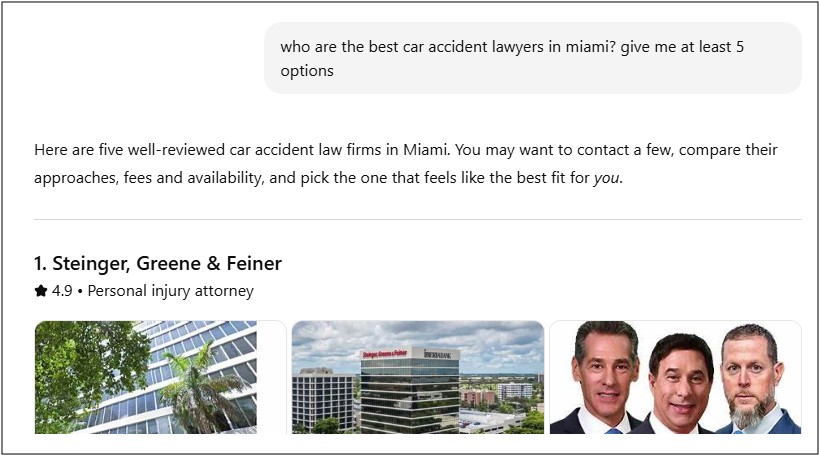
The reality is that search today doesn’t fall into neat buckets. AI platforms are strongest for informational queries but can also surface attorney recommendations. Google still dominates commercial and transactional searches, yet its own AI features increasingly influence early-stage research.
In other words, different platforms often handle different parts of the journey, but they increasingly overlap. Your SEO strategy has to account for all of it, with an emphasis on where your potential clients actually make hiring decisions.
SEO Tactics for Personal Injury Firms
An SEO strategy is your big picture plan. It’s what you hope to achieve and where you’ll invest your budget.
For example, a strategy for a brand new personal injury firm may include:
- Targeting core case types like car accidents or slip and falls.
- Focusing on communities or suburbs closest to your office.
- Building brand awareness online and offline so you can expand into a broader region over time.
SEO tactics are the specific actions used to carry out that strategy. For personal injury firms, the most important tactics include:
- Local SEO, including your Google Business Profile
- Content
- Technical SEO & web development
- Off-page SEO
If you’d like to learn more about executing an SEO plan, see our complete guide to optimizing your website.
Local SEO
Local SEO is the most important part of SEO for most personal injury firms. Personal injury attorneys primarily serve clients in their city and surrounding communities, which makes local search traffic absolutely essential.
Some common tactics used to implement a local SEO strategy include:
- Creating and managing a Google Business Profile (GBP) for every office location, and setting your business hours to 24/7 if you have an answering service.
- Building local citations, especially in legal directories and local business listings.
- Writing hyper-local content that shows your firm’s presence in and understanding of the community you represent.
- Encouraging client reviews and responding to every review your firm receives, even the negative ones. Develop an internal process to consistently ask clients for reviews.
- Optimizing your website for mobile users because many who search for a personal injury attorney do so on their phone.
- Using local schema markup to help search engines understand your business and location data.
Local SEO remains one of the highest-ROI opportunities for personal injury firms because it connects you directly with people actively seeking help.
Content
With so many firms relying on AI to churn out generic articles, authentic, expert content is more important than ever. Both search engines and AI platforms prioritize content that’s helpful and demonstrates actual expertise and insight.
Some of the content tactics we may use for personal injury firms include:
- Revamping old content to improve quality, depth, and insight.
- Writing new practice area pages that clearly articulate your firm’s strengths, successes, and perspectives on the legal cases you handle.
- Building supporting content that answers long-tail questions, which is especially important as AI search uses query fan-out systems to explore related topics and generate more complete answers.
- LinkedIn and other social posts to build topical authority in your key practice areas.
- Press releases and earned media, which we coordinate with off-page efforts to strengthen your reputation across the web.
High-quality content demonstrates real expertise and works with other SEO efforts to build your firm’s reputation and visibility.
Technical SEO & web development
Good SEO can’t reach its potential on a poorly built site. A high-performing personal injury site must be fast, usable, and easy for search engines to crawl. Our web developers audit and fix the structural issues that hold websites back.
- Improving core technical metrics, including site speed, mobile responsiveness, and crawlability.
- Adding structured data (schema) to clarify your services, attorneys, locations, and reviews.
- Optimizing metadata and on-page structure, including internal links and title tags.
- Enhancing conversion, such as by reviewing and optimizing forms, chat options, and CTAs, and displaying social proof like case results and testimonials.
Better technical performance and design facilitate stronger visibility and more visitors converting into cases.
Off-page SEO
Off-page SEO focuses on strengthening your website’s authority and reputation across the web. These efforts don’t happen on your site, but they affect how well it performs, not just in traditional Google search but in AI search too, as brand mentions appear correlated with AI visibility.
Some of the tactics used to boost your reputation around the web include:
- Auditing your website’s backlinks and brand mentions to evaluate the quality and health of external sites linking to or referencing your firm.
- Auditing your competitors’ backlinks to uncover opportunities and advantages.
- Building backlinks from trusted legal websites, local media, industry publications, and relevant organizations.
- Creating citations in legal and local directories with consistent NAP (name, address, phone) information.
Off-page efforts such as these are proving vital for traditional SEO as well as visibility in AI platforms.
Tactics to Improve Personal Injury Firms’ AI Visibility
Generative engine optimization (GEO) refers to increasing your firm’s visibility in AI search, including large language models (LLMs) like ChatGPT, Gemini, and Perplexity, as well as Google’s AI features such as AI Overviews and AI Mode.
The good news?
Tactics that help traditional search are largely the same tactics correlated with AI search visibility.
- Offsite efforts to boost brand mentions
- Offline community engagement
- Unique, digestible, experience-based content
- Building a sound website
Not surprisingly, more and more personal injury firms are asking us about GEO, hoping to gain visibility on AI chatbots like ChatGPT, Gemini, and Perplexity.
But it’s equally important to recognize that traditional search remains dominant, especially when users are ready to hire a lawyer. Google often does not produce AI Overviews for commercial or transactional queries, meaning local packs, organic results, and LSAs continue to drive many personal injury leads.
In 2024, Google reported 5 trillion searches, dwarfing usage across the AI platforms.
While AI hasn’t replaced Google’s local results for most hire-intent searches, ignoring how quickly AI and user behavior are evolving would be a mistake.
That’s why AI visibility is built into every strategy we develop at We Do Web. A winning plan must reflect your firm’s goals and position you where potential clients are looking, whether that’s Google’s traditional results, local maps, LSAs, or LLMs like ChatGPT and Gemini.
And with all of these moving parts, your strategy has to be measured by the results it produces.
Measuring ROI for Personal Injury SEO
Personal injury SEO is one of the most competitive online spaces, and you need to know every dollar you spend is powering efforts that move the needle for your firm.
SEO metrics for personal injury law firms
Your SEO agency should report both how you’re performing in search and how your SEO budget contributes to leads and signed cases.
Here are some of the most important metrics for personal injury firms:
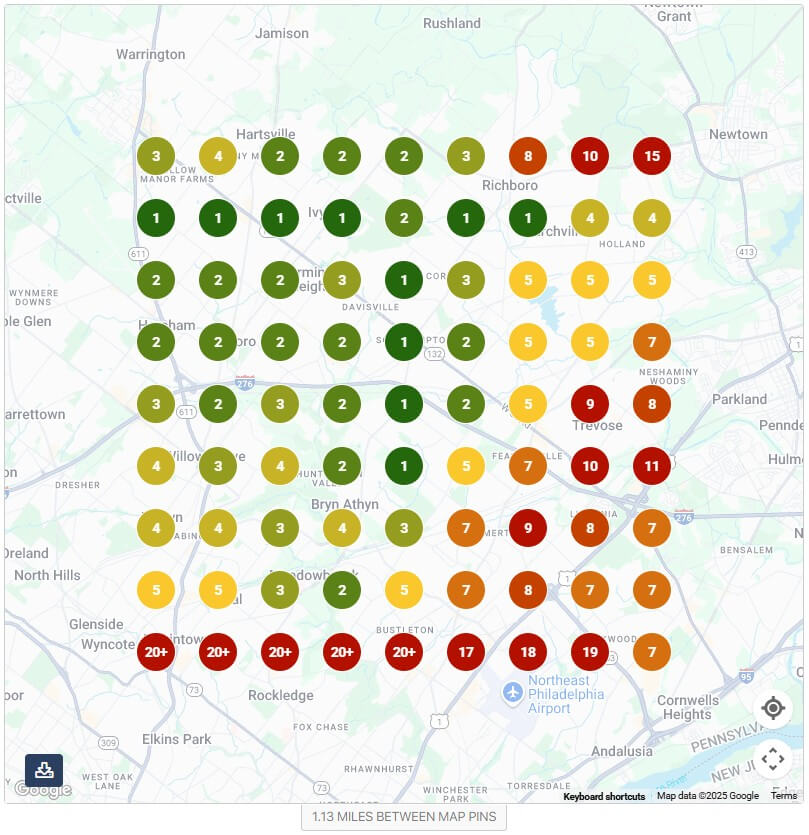
Local search visibility via software like Local Falcon reveals your firm’s presence in local map packs for searchers in the areas around your office and service area. A heat map provides a clear visual of your firm’s presence in those local map packs.
Organic rankings are still useful metrics for personal injury firms. Google returns AI Overviews at lower rates for transactional and commercial queries (e.g., “car accident lawyer near me,” “Miami injury lawyer”), making Google’s organic and map results central to how users hire attorneys when they search in Google. (See how we helped a personal injury firm drastically expand its keyword ranking in the top 3.)
Traffic still matters for law firms, but differently than it used to. AI Overviews and LLMs have reduced informational traffic for many websites. And many transactional and commercial searches return local map packs, allowing users to call firms in their area without visiting their websites. That means declining numbers may not necessarily reflect declining performance. Monitor your traffic so you’re aware of how users are interacting with your site and web presence, but be sure to interpret it within the context of modern search behavior.
Leads are the most practical measure of SEO performance for most personal injury firms. They show whether your visibility is turning into real opportunities. If leads are high but case sign-up rates are low, the issue often lies in intake, including response times and insufficient follow-up processes.
Signed cases are ultimately the reason you invest in SEO. Tracking which channels deliver signed cases (organic, maps, LSAs, or even offline channels) is essential for understanding ROI. A reliable attribution system makes this possible.
When comparing agencies, find out how they assess whether their strategy is working. Which metrics do they rely on? How do they interpret them? And how do they determine when to refine the plan?
Choosing an SEO Agency for Your Firm
As you evaluate SEO agencies for your firm, prioritize those that specialize in legal SEO, build custom strategies, and offer full-service SEO.
Ask SEO agencies these questions:
Do you specialize in SEO for law firms?
Legal SEO is different from other industries. It requires a deep understanding of:
- Local SEO (the backbone of online marketing for personal injury firms)
- Legal-specific schema
- The unique nuances of personal injury law and terminology
- Intake systems and response workflows
- Ethical and advertising rules that restrict law firm marketing
Agencies that serve every industry often overlook these nuances, and that gap becomes clear in competitive personal injury markets. An SEO agency specializing in the legal industry knows what drives leads, how to comply with marketing rules, and how injury victims actually behave online.
Do you offer full-service SEO?
Some agencies only handle one piece of the puzzle, such as content or link building, forcing your firm to hire multiple vendors to execute a single strategy. That can create confusion, misalignment, and wasted resources.
A strong agency should manage all core SEO tactics in one place:
- Strategy & planning
- Local SEO
- Content
- Technical SEO & development
- Off-page SEO
It’s normal for SEO and PPC to be separate, but your SEO partner should cover everything required to effectively execute an SEO strategy.
How do you develop SEO strategies?
Be wary of agencies claiming to have a “formula,” “insider method,” or fully automated process for ranking in traditional or AI search. That usually means they’re using the same template for every client. Your SEO agency should tailor your strategy based on:
- Market
- Practice areas
- Budget
- Goals
- Competition
- Starting point
A one-size-fits-all approach will not work in personal injury. The competition is too high.
How do you monitor my firm’s progress?
Your SEO agency should report data that actually measures your firm’s growth, not vanity metrics. Are they reporting:
- Rankings and local presence?
- Traffic interpreted in context?
- Leads and signed cases?
- Progress against your goals?
At We Do Web, we meet with our personal injury clients at least once per month to review meaningful metrics and adjust our strategy as needed. SEO is dynamic, and your agency should proactively steer the ship.
Will my website be on a proprietary platform?
Some agencies host your site on their own proprietary platform. That often seems convenient, until you try to leave. Migrating off these platforms can be costly, time-consuming, and technically painful.
Always ensure you own your website and that it’s not hosted on the agency’s proprietary platform.
Red flags to avoid when choosing an SEO company
As you evaluate your options, watch out for these red flags:
- Guaranteeing results. No one can guarantee specific rankings or AI visibility. Promises of “secrets” or “special formulas” usually lead to disappointment.
- Hosting your site on its platform. If an agency insists on hosting your site on its private platform, assume the exit will be difficult.
- Narrow or templated SEO plans. If they’re not auditing your site or asking questions, they’re not building a strategy. They’re selling a template, often one that doesn’t account for today’s search, including AI and LLMs.
- Automated SEO. Low-priced SEO powered entirely by automation or AI is a major red flag. AI can support SEO, but it can’t replace the strategic thinking and expertise needed to develop and implement a strategy.
See Why Personal Injury Firms Work With We Do Web
Here’s what you get when you partner with us:
- Free site audit: Our free site audit uncovers blind spots and weaknesses in your firm’s SEO that could be holding your site back.
- Roadmap tailored to your personal injury firm: Every personal injury firm gets a custom SEO strategy aligned with its growth goals. No cookie-cutter strategies.
- Dedicated account manager: You’ll meet with your account manager regularly to review performance, track progress toward your goals, and adjust strategy as needed. The focus is always on helping your firm sign more of the right cases.
- 15+ years helping personal injury firms: When you work with We Do Web, you’re partnering with a team deeply rooted in legal marketing. We’ve helped personal injury firms at every stage, and we know what drives growth.
Is your firm leaving opportunity on the table? Let’s find out.
FAQs About Personal Injury SEO Agencies
What should an SEO proposal include for personal injury firms?
An SEO proposal should include a fee schedule, the scope of work, and a service agreement that defines the relationship.
It should also outline exactly how time and resources will be allocated each month. That includes how much content the agency will produce; the number of links it will build (or the link-building budget); the hours dedicated to technical SEO work such as site health, schema, and tracking and analytics; and the time allotted every month for each of the other services included in the proposal.
Be sure the proposal also clarifies which site(s) the agency will work on, expectations for delivering and reviewing work that requires your approval, how and when fees will be paid, your responsibilities in the partnership, and any details unique to the scope of work or project you’ve discussed with the agency.
Should personal injury firms invest in marketing channels other than SEO?
Firms wishing to accelerate growth often invest in additional digital channels, including social media marketing and paid advertising such as Google PPC, Local Services Ads (LSAs), and social media ads. Many agencies (including We Do Web) can facilitate both SEO and paid campaigns.
Many personal injury firms also invest in offline channels like TV, radio, and community signage (billboards, buses, benches, etc.). Offline brand awareness can reinforce your digital presence by increasing branded searches, brand mentions, and backlinks, all of which can improve organic and AI visibility.
What personal injury lawyer keywords do SEO agencies target?
The search queries your SEO agency targets depend on your case types and market. Most personal injury strategies focus on visibility for terms like:
- “personal injury lawyer/attorney”
- “car accident lawyer/attorney”
- “truck accident lawyer/attorney”
- “slip and fall lawyer/attorney”
Keyword targets may span multiple locations, from major metros to smaller suburbs in your service area. A keyword research tool like Ahrefs or Semrush helps identify queries relevant to your practice.
That said, modern SEO extends far beyond basic keyword matching. Google has been equipped for semantic search for years, and We Do Web has long prioritized topical relevance, subject matter depth, and expertise over exact-match keyword tactics. These same strengths now matter even more as both Google and AI search systems interpret meaning and context, not just repeated phrases.
What pricing models do SEO agencies use for personal injury firms?
Most SEO agencies charge a monthly fee for their services. Pricing varies widely based on the investment required to reach your firm’s unique goals, whether that’s aggressive growth, steady long-term visibility, or something in between.
Your firm’s current website, web presence, and AI visibility can also influence the budget needed to reach your goals. A firm with a minimal web presence may need more foundational work than an established firm, for example. Factors like site rebuilds, large content campaigns, and link-building accelerators can influence the required investment.
Your available resources and desired pace of growth also play a role. A higher budget can accelerate results, while a more modest investment can still work with the right expectations. The key is to collaborate with your agency to determine a budget that aligns with your resources and goals and the timeline you have in mind.
What common mistakes do personal injury firms make when hiring an SEO agency?
The biggest mistake personal injury firms make is hiring a budget SEO provider. Low-cost agencies often rely on automation, outdated tactics, or templated plans that cannot compete in the personal injury space. Months (or years) of fees (even modest ones) add up with little to show for it, and the next agency must first fix the damage before executing a real growth plan.
To avoid this, choose an agency that:
- Understands the legal industry
- Builds tailored strategies
- Has the resources and expertise to execute at a high level
When done correctly, SEO can generate substantial growth in qualified leads and signed cases, often paying for itself and enabling reinvestment into further marketing.
